
Getting Started with Ansible training Course – Simple, Powerful, Agentless Automation for Your Infrastructure
- Price
- Duration
- Number of hours
Each session will take place even if only one person is registered (except in cases of force majeure).

Description of this Getting Started with Ansible training Course
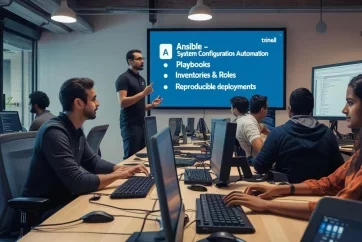
Ansible is one of the most widely used automation tools in modern DevOps environments. Thanks to its declarative, agentless approach, it allows you to deploy applications, configure systems and orchestrate complex tasks in a reproducible, secure and easy-to-maintain manner.
This Ansible training course provides you with all the basics you need to master playbook writing, manage inventories, organise your roles and automate production scenarios on your Linux or cloud servers.
Format
Remote (recorded sessions).
GOOD TO KNOW
This training course includes numerous exercises (60% practical) to enhance learning. Each session will take place even if only one person is registered (except in cases of force majeure). A preliminary interview is held between the participant and/or a company representative in order to fully assess the participant’s profile (level, needs, professional context, challenges, etc.).
Assessment : during the training course, the trainer assesses the participants’ progress through multiple-choice questions, role-playing exercises and practical work. Participants receive a certificate of completion at the end of the training course.
objectives of this Getting Started with Ansible training Course
By the end, each participant will be able to :
- Understand how Ansible works and its agentless model.
- Write reusable playbooks to automate recurring tasks.
- Manage inventories (static and dynamic) and environment variables.
- Use roles to structure your code and promote maintainability
- Deploy services and applications at scale
- Apply security best practices (Vault, sudo, user management)
Prerequisites of this Getting Started with Ansible training Course
- Basic knowledge of Linux command line
- Basic system administration skills (configuration files, services, packages)roficiency with a text editor and YAML files
- Because each participant has a unique background and expectations, a preliminary interview with our expert allows us to precisely identify their objectives, level and professional challenges.
This enables us to tailor the training content to ensure relevant and personalised learning.
TARGET AUDIENCE
Ideal training for developers, sysadmins, DevOps engineers, or integrators who wish to standardise and improve the reliability of their IT operations.
Detailed of this Getting Started with Ansible training Course
Introduction to Ansible
Architecture, operation, agentless mode, advantages over other tools (Puppet, Chef, etc.).
Inventories and variables
Static inventory (INI/YAML file), host groups, variable management.
Playbooks and modules
Playbook syntax, common modules (apt, yum, copy, template, service, etc.), error handling and conditions.
Roles and factorisation
Organisation of playbooks into roles, reusability, variables per role, default files and vars.
Security management
Using Ansible Vault, sudo, user deployment, SSH key management.
Application deployment
Case study : deployment of a web stack (Nginx, app, database), management of handlers and dependencies.
Structure and best practices
Project structure, idempotence, debugging, testing, infrastructure as code maintenance.
The advantages of this training course
This training course :
- Focuses on practical applications and business cases
- Provides a clear overview of infrastructure as code that is accessible to all
- Links manual scripting with long-term automation
- Enables rapid skill development that can be applied immediately

FORMA-IT's training courses are also supportive
At Forma-IT, we believe that training can also be a lever for solidarity. This is why part of each registration is donated to associations that work in areas that are close to our hearts :
- The SPA, for animal protection
- The Restos du Cœur, for the fight against precariousness
- Ludopital, to make the daily lives of hospitalized children easier
- APF France Handicap, for the rights of people with disabilities and their families
By choosing Forma-IT, you invest in your skills while contributing to essential causes.
Our related training courses

Ansible Training Course– Master DevOps Automation from Configuration to Continuous Integration
Gain reliability and speed through automation with Ansible in your infrastructure and deployment projects.
Ansible Training Course– Industrialised Deployments and Structured Automation on a Large Scale
Optimise fleet management and application deployment.

Git Training Course
Understand, practise, and automate Git for efficient and reliable workflows.

Advanced Git Training Course
Deepen your Git expertise for complex projects, structured teams, and clean deliveries.

GitLab CI/CD Training Course
Create robust, scalable, and secure pipelines to accelerate your delivery.

Docker Training Course
Optimise the portability, scalability, and reliability of your deployments with Docker.

Advanced Kubernetes and CI/CD Training Course
Customise your pipelines, master scalable architectures, and manage your deployments from start to finish.

Kubernetes Training Course
Drive robust, scalable, and automated cloud-native architectures with Kubernetes.
Would you like to know about upcoming sessions ?
Would you like to schedule this Ansible Training Course on a specific date ? Contact us by email or by filling out the contact form.